Terse Reference
|
Full Reference
|
Likely Source
|
William Humphrys, Engravings by William Humphrys Scrapbook, James Fraser, ca. 1817 - circa. 1844 (1846?)
|
The Library Company of Philadelphia, plausibly the only copy ever made
| |
Engravings from The Choicest Works of Sir Thomas Lawrence, P.R.A., Henry Graves & Co., 1846
|
Art or print museum, university library, antiquarian bookstore
| |
The Philatelic Society, London, The Postage Stamps, Envelopes, and Post Cards of Australia and the British Colonies of Oceania, The Philatelic Society, London, 1887
|
Philatelic library / second hand bookstore / modern reprints are also available and discoverable at abebooks.com
| |
Charles H. Mottram, Remarks on the Early Postal Rates of New Zealand with Notes on the First Issued Stamps, Royal Philatelic Society London, vol. 4, no. 42, pp.154-159, June 1895
| ||
Cyclopedia Company Ltd, The Cyclopedia of New Zealand, Cyclopedia Company Ltd, 1897
| ||
Alfred Whitman, Nineteenth Century Mezzotinters: Samuel Cousins, George Bell & Sons, 1904
|
Philatelic library / second hand bookstore / modern reprints are also available and discoverable at abebooks.com
| |
William Jolliffe, The History of New Zealand Stamps, Philatelic Society of New Zealand, 1913
|
Philatelic library / second hand bookstore
| |
Fred J. Melville, “Postage Stamps in the Making: Volume 1”, Stanley Gibbons, 1916 (another wrote the second volume)
|
Philatelic library / second hand bookstore / modern reprints are also available and discoverable at abebooks.com
| |
R.J.G Collins, New Zealand: A Philatelic Handbook, Verne & Co, 1922
|
Philatelic library / second hand bookstore
| |
R. B. Yardley, The Portrait of Queen Victoria on the Plates of Queensland and Other Countries Engraved by Messrs. Perkins, Bacon & Company, in The Postage Stamps, Envelopes, Wrappers, Post Cards and Telegraph Forms of Queensland, A. F. Basset Hull, Royal Philatelic Society London, 1930
|
Philatelic library / second hand bookstore
| |
Edward D. Bacon. Three of Edward Henry Corbould’s drawings for Colonial Postage Stamps and Mr J.W. Levinge’s Original Sketch for the First Five Shillings Postage Stamp of New South Wales, Royal Philatelic Society London, vol. 42, no. 496, pp.76-79, 1933
| ||
R.J.G. Collins and H.T.M Fathers (editors), The Postage Stamps of New Zealand (Volume I), Philatelic Society of New Zealand, 1938
|
Philatelic library / second hand bookstore
| |
R.J.G. Collins and C.W. Watts (editors), The Postage Stamps of New Zealand, Volume II, Royal Philatelic Society of New Zealand, 1950
|
Philatelic library / second hand bookstore
| |
Julian Blanchard, “Chalon’s Victoria on Bank Notes”, The Essay Proof Journal, 1951, vol. 8, no. 3, p131-136
| ||
“The Chalon Portrait (From ‘A Review: 1945-1946,’ Robson Lowe Ltd., London”, reprinted in The Essay Proof Journal, 1951, vol. 8, no. 3, p142-143
| ||
R.C. Tombs, “Queen Victoria and the Exhibition Portrait”, The Stamp Collectors’ Fortnightly, London, 16 June 151; reprinted in The Essay Proof Journal, 1951, vol. 8, no. 3, p144-145
| ||
John Wilson, The Royal Philatelic Collection, The Dropmore Press, 1952.
|
Philatelic library / second hand bookstore
| |
Percy de Worms, Perkins, Bacon Records: Volume I [up to p526] and Volume II [p531 onwards], Royal Philatelic Society London, 1953
|
Philatelic library / second hand bookstore
| |
Robson Lowe Ltd, The Chalon Portrait, Journal of the Royal Society of Arts, vol. 103, no. 4949, 15 April 1955
| ||
R.J.G. Collins and C.W. Watts (editors), The Postage Stamps of New Zealand, Volume IV, Royal Philatelic Society of New Zealand, 1964.
|
Philatelic library / second hand bookstore
| |
J.W.M. Stone, The Colonial and Foreign Dies of Perkins, Bacon & Co. 1847-85, Royal Philatelic Society London, vol. 77, no. 911, pp.224--233, 1968
| ||
J.W.M. Stone, The Colonial and Foreign Dies of Perkins, Bacon & Co. 1847-85, Royal Philatelic Society London, vol. 78, no. 915, pp.65-69, 1969
| ||
J.W.M. Stone, The Colonial and Foreign Dies of Perkins, Bacon & Co. 1847-85, Royal Philatelic Society London, vol. 78, no. 916, pp.93-97, 1969
| ||
J.W.M. Stone, The Colonial and Foreign Dies of Perkins, Bacon & Co. 1847-85, Royal Philatelic Society London, vol. 78, no. 917, pp.125-131, 1969
| ||
J.W.M. Stone, The Colonial and Foreign Dies of Perkins, Bacon & Co. 1847-85, Royal Philatelic Society London, vol. 79, no. 920-921, pp.225-229, 1969
| ||
Michael P. Vort-Ronald, Banks of Issue In Australia, Royal Philatelic Society London, Michael P. Vort-Ronald, 1982
|
Numismatic library / second hand book dealer
| |
John B. Marriott, Comments on a display from the Royal Philatelic Collection …, Royal Philatelic Society London, vol. 94, no. 1105-1106, pp.13-23, 1985
| ||
Fine Victorian Prints, THERMAL-3311, auction catalog, Christies London, 14 February 1986, especially lot 60 (sold for ₤1080)
|
Auction catalogue dealer
| |
Anonymous The Chalon Head, The Philatelist-P.J.G.B, p216, September-October 1987
|
Philatelic library / second hand bookstore
| |
Robson Lowe, The Chalon Portrait, The Mail Coach, vol. 30, no. 4, April 1994
|
Philatelic library / second hand bookstore
| |
Victor F. Smith, The Origin of the Large Chalon Head, Royal Philatelic Society London, vol. 100, no. 1117-1118, pp.4-11, 1991
| ||
Delia Millar, The Victorian Watercolors and Drawings in the Collection of Her Majesty the Queen, Philip Wilson Publishers, 1995
|
University library / second hand bookstore
| |
John Dickson, The Design and Engraving of Perkins Bacon Stamps Based on the Chalon Portrait, Royal Philatelic Society London, vol. 109, no. 1281SUP, 28 January 2000
| ||
Renniks2004
|
Eddie J Cummings, Renniks Australian Coin & Banknote Values, Renniks Publications, 2004
|
Numismatic library / second hand book dealer
|
George S. Cuhaj, Standard Catalog of World Paper Money, Specialized Issues, 10th Official Edition, KP Books, 2005
|
Numismatic library / second hand book dealer
| |
Robert P. Odenweller, The Postage Stamps of New Zealand: 1855-1875, The Chalon Head Issues, Royal Philatelic Society London and Royal Philatelic Society of New Zealand, 2009
|
Philatelic library / second hand bookstore
| |
Stanley Gibbon Commonwealth & British Empire Stamps, 1840-1970, Stanley Gibbons, 2014
|
Philatelic library / second hand bookstore
| |
Anonymous, The Western Australian Bank (1841 - 1927) Underwritten by Parochialism, undated, retrieved March 2019
| ||
Anonymous, Colonial Queensland Chalon Head 1882, Archival Snapshots from the National Philatelic Collection, undated, retrieved March 2019
| ||
Anonymous, History of Jacobs Perkins in the Printing Industry, Baker Perkins Historical Society, undated, retrieved March 2019
| ||
Anonymous, Centenary Philatelic Society of New Zealand, New Zealand Post Limited, undated, retrieved March 2019
| ||
Debbie McCauley (last editor), Tauranga Library (est. 1871), May 2017 (last edit) , retrieved March 2019
| ||
Email with a member of the Heritage and Research Team, Information Access Specialist (Libraries), Tauranga City Council
| ||
Anonymous, Bank of British North America - Banknotes, undated, retrieved March 2019
|
Sunday, April 7, 2019
Chalon References

What about the Perkins, Bacon & Co. bank-notes that also bear a Victoria vignette?
1. The First Draft of History
When the history of the New Zealand Chalons first begins, there is no mention of bank-notes [Mottram1895] [Meville16].
For the New Zealand reader, the first hints of the bank-note engravings, which are actually the crucial first leg of the journey, come in [TPSoNZ38v1, p32-33]. “The selection of the design for the first adhesive stamps of New Zealand was arranged between the representatives of the New Zealand Government in London and Messrs Perkins, Beacon & Co. … Humphrys … was entrusted with the cutting of the portrait … As the first stage in the production of the plates, Humphrys engraved the central portrait only … An essay is known in which the portrait is more extensive than in the stamps, and the engine-turned background was also larger. It was surrounded by an ornamental circular frame without any inscription [i.e. the half-length engraving]. In another essay the portrait was reduced in extent … Ultimately the general lay-out of the design was agreed upon …”
Two observations must be made:
1. As we shall see this language (significantly contracted above but otherwise unadulterated) provides some misdirection, since the order of the quoted events as written is not the chronological order that we understand today. In the modern history, Humphrys engraved a three-quarter length portrait and thence constructed a half-length portrait long before the representatives of the New Zealand Government came calling. The reduced portrait was already in use on other projects and seems to have been slotted into the New Zealand commission.
2. Recall that scaling a design, given the technologies of the day, was roughly equivalent to re-engraving the design from scratch; and certainly the three-quarter or half-length engraving was too large for a stamp so it seems unlikely to this author that either were a competing design element that sparked disagreements about the stamp’s general lay-out.
But indeed there was a delay, and [TPSoNZ38v1, p29] writes “From the existence of essays it appears that the non-fulfilment of the clause in the tender concerning the execution of the order within three months, was due to modifications of the original design.” There is a tantalising hint that a wider bust was considered, since [Odenweller2009, p231] publishes a Chalon proof hand-cut to a circle that encloses the just the bust and slightly more of the ermine cape. An alternative explanation for the delay may be culled from [PBR53, p.xvii] “A comparative study is helpful in revealing the pressure of work which fell on the firm [Perkins, Bacon & Co.] at certain periods, particularly against the backdrop of the contract for printing the stamps of Great Britain. At first sign the frequency with which promises had to be broken …” That is, the New Zealand stamps may have been delayed simply because Perkins, Bacon & Co. committed to more projects than it could fulfill in time, and New Zealand’s stamps were lower priority than other commissions.
|
At the Stamp Centenary Exhibition of May 1940, black and blue commemorative labels were published by the Royal Philatelic Society London. “The description which accompanied the publicity for these labels stated ‘The plate made for these labels has been prepared from the actual roller die used for the engraving of certain Australian bank drafts’” [Dickson2000, p8]. Yet the ornamental greenery in this engraving cannot be found in any Australian bank-note [VortRonald82].
[TPSoNZ50vol2, p226] shows a half-length Chalon vignette in a jagged ornamental border and additional peripheral lines. The image is captioned “Original essay with portrait engraved by William Humphrys”. To this author, the vignette closely resembles the design first seen in the 4-digit-year series of Union Bank of Australia bank-notes, first issued circa 1878. However, this is 20 years after the non-jagged version was first released and over 10 years after Humphrys’ death. Perhaps Humphrys created it as a design proposal that was initially unsuccessful, then it gathered dust for some years before being resuscitated for the Union Bank of Australia. Or perhaps the image is miscaptioned.
[Lowe55, p345] makes two claims that do not accord with our modern knowledge:
1. Lowe reports “During the fifties, Humphrys also engraved another copy of the portrait very similar to that which appears on the stamps of New Zealand, but in this case the three-quarters length … ” which this author interprets as “engraves from scratch”. Yet we now know that the three-quarter length portrait was on an issued bank-note earlier than the 1850s.
2. Lowe continues “Another transfer of Humphrys engraving [i.e. the non-existent ‘fifties’ engraving] was used by Perkins, Bacon & Co. for producing the early bank notes of Western Australia.” But this reference to Western Australia must be astray since:
· The Bank of Western Australia had merged into the Bank of Australasia very early, in 1841. Only one series of notes is known and it bears text but no graphic elements.
· The Western Australia Bank, formed 1841, always used the swan as its motif on bank-notes, and Victoria was nowhere to be seen. Recall that Western Australia was first known as the Swan River Colony, due to the settlement at Perth (on the Swan River). For the first few decades, this fledging colony used a swan, not only for the Western Australia Bank bank-notes as described but also as its motif on its stamps too [WesternAust] [SGCBES2014, p39-41]
Meanwhile [Lowe55, p344], likely assisted by [Blanchard51] provides a helpful initial list of engravings of the Chalon portrait by various enterprises in North America.
[TPSoNZ64v4, p3] upgrades the “Western Australia” to the “Bank of Western Australia” and applies it to the [TPSoNZ50vol2, p226] vignette, but otherwise is closer to our modern understanding. [TPSoNZ64v4, p2-3] illustrates the vignette for a 20 shilling bank-note, but no bank nor date is ascribed, and the implication is that the answer is unknown to the editors and perhaps to all the philatelists of their acquaintance. [TPSoNZ64v4, p2-3] also illustrated an engraving of Victoria in a medallion, “stated to have been used for the Bank of British North America” [modern day Canada] yet their issued bank-notes always used the three-quarter portrait. [Pick2005, p142].
In short, the Perkins, Bacon & Co.-related bank-note details provided by [TPSoNZ38v1], RPSL, [Lowe55], and [TPSoNZ64v4] do not provide us with a robust historical foundation.
2. Back on Track
[Stone69n915, p65] provides information that has yet to be falsified “In 1846 William Humphrys made a three-quarter-length engraving of the Queen … possibly for the North American banknotes on which it was later used … A further, half-length, version was used for Australasian banknotes …” But which North American and Australasian bank-notes?
It is not until 2000, decades after the first topic first arose, that more or less complete answers appear in the philatelic literature, in Dickson’s esteemed paper. Dickson writes “His [Stone’s] illustration … [of the 20 shilling banknote vignette] appears to have been taken from a Nova Scotia issue of 1848.” [Dickson2000, p7]
Just wow!
We have gone from a mystery design, apparently an essay for a failed commission that never saw the light of day, to an actual banknote!
Equally as remarkable, a Google search led to the uncovering of a recently scanned scrapbook, and a still-earlier Humphrys engraving for bank-notes.
It is worth noting that the numismatic community have done an outstanding job of cataloguing and publishing the history of bank-notes, and an important lesson here is to consult their work early and often when considering vignettes for bank-notes. For instance:
· The Nova Scotia bank-note design precedes the Chalon bank-notes from the Bank of British North America, which used other vignettes until the latter bank’s first Chalon issue in 1852 [CoinsAndCanada].
· This author cannot discern any other North American notes by Perkins, Bacon & Co. from [Pick2005], although there are many Chalon banknotes by other engraving enterprises.
· [TPSoNZ64v4] introduces the Union Bank of Australia as an issuer of Chalon bank-notes. The excellent description in [VortRonald82, p223-230] reports that the first bank-notes included a (non-Chalon) vignette of Victoria seated in a throne, but the issued bank-notes from 1854 to 1905 all bore an engraving of the Chalon portrait, and all were printed by Perkins, Bacon & Co. until 1893. In New Zealand then the first Chalon bank-notes followed the first Chalon stamps, since the second series of bank-notes bearing the Chalon vignette “were first introduced [to New Zealand] at the Christchurch Branch on March 1, 1859” [TPSoNZ64v4, p3].
· Australia also saw Chalon bank-notes from the Bank of Victoria, whose first bank-notes bear a three-quarter length Victoria vignette as described in [VortRonald82, p113-116]. This reference lacks dates, but [Renniks2004, p155] lists 1853. Meanwhile [Lowe94, p154] wrote “Quite recently, I have come across another past-up essay for a Bank Note, made by Perkins, Bacon and Company for Victoria.” [Odenweller2009, p12 and p231] publishes two elegant specimens.
The Cousins Cornucopia
As described in the modern, illustrated history of the New Zealand Chalons, Chalon’s portrait of the young Victoria was engraved by Samuel Cousins in order for portrait-sized prints to be made. Let us now peer into the history of Cousins' work.
[Mottram1895, p158] is quite specific when he writes “A very fine mezzotint was produced of … [Chalon’s] portrait by the late Samuel Cousins, R.A., and published May 1st, 1839, by Alderman F.G. Moon, by Special Appointment Publisher in Ordinary to Her Majesty [Victoria]”. This sentence stands alone in the text: that is neither in this sentence, nor in the ones before or after it, does Mottram state that the mezzotint portrait engraving specifically inspired the engraving work for the New Zealand Chalons.
Cousins’ engraving had some level of official status, hence the involvement of the Publisher in Ordinary to Her Majesty. Cousins was fortunate enough to be invited to a sitting with the young Queen to refine his engraving [Whitman04, p105] when, perhaps because the Chalon oil painting inevitably lacked the detail needed for an engraving [Smith91, p5], or perhaps for royal oversight.
The next reference [Melville16, p64] refers to “the mezzotint of … [the Chalon] portrait, by Samuel Cousins, R.A.” but omits any reference to Cousins at [Melville16, p68] where it says “He [Humphrys] engraved the reproduction of the portrait by Chalon (q.v.) for the first stamps of New Zealand …”
[TPSoNZ38v1] refers to Cousins not at all.
Our mystery beings in 1955 when Robson Lowe [Lowe55, p343] referred to an 1838 engraving, namely “In 1838 Samuel Cousins made a fine steel engraving, …” Furthermore, engraving a mezzotint is easier when the plate comprises a softer metal such as copper, whereas other techniques are preferred for the harder steel plates, such as stipple, so Lowe’s language hints that the mezzotint characterization was controversial also.
[TPSoNZ64v4, p2] echoes [Lowe55]’s date and reports that “In 1838, Samuel Cousins made an engraving copied from one of the Chalon paintings. One copy of this beautiful engraving hangs in the stairway at the Tauranga Public Library.”
This is no longer the case. The engraving has not been on display at Tauranga Library since before at least 2000, nor even listed in a recent inventory of the Civic Art Collection [TaurangaAskALibrarian]. The current location of the engraving seems to be unknown and perhaps even unknowable. Still, one wonders if the engraving was:
· Put into storage, subsequently mislaid, yet still discoverable. Certainly all or portions of the Tauranga library and the associated archives have moved sites many times since 1964: likely in October 1964 (since it seems likely that the text of [TPSoNZ64v4] was completed before this date) and then again in 1970, 1974, 1976, 1987, 1988 and 1989 [TaurangaLibHist].
· Accidentally destroyed, or irredeemably damaged then “put out of its misery”. Indeed there was a fire in 1976, a major leak in 1984, another leak in 1987, ongoing rainy-day leaks during 1989-2007, and damage from Treaty of Waitangi-related protests in 1988 [TaurangaLibHist]
· Sold off as surplus to a philatelist (or royalist)
· Purloined
|
These apparent inconsistencies seem to be delightfully resolved by [Smith91, p5]. There was not one Cousins print, nor two, but four different prints. “Two different versions of the portrait were produced, and each was published in two conditions, initially as an etching with some mezzotint shading, and finally as a mixed stipple and line engraving. The first version was about 75 cm by 50 cm (the same size as the extant [Portuguese Chalon] copy and presumably the same size as the original painting) and was published in February and June 1838: the second version, smaller at 60 cm by 40 cm, was published in October 1838 and May 1839. All were published by Francis Graham Moon of Threadneedle Street, and the printers were Dixon and Ross …”
It is worthwhile noting that the tradition of the day was for the engraver to inscribe the publishing date on the plate before making prints from it. However, for engraving, this need not be the end of the creative process. If the engraver sees some further opportunity for improvement, there is nothing to stop him refining his engraving, updating the date, then printing off additional copies. Each evolutionary dated plate is called a state (or condition) of the plate.
Smith never explicitly matches up his versions and conditions with his dates, but does indicate that his reference was the British Museum. From the meta-data at the British Museum website, the four prints were:
· Feby 1, 1838: larger version, characterized as: mixed, mezzotint, etching (and subsequently hand-coloured)
· June 28, 1838: larger version, characterized as: mixed, mezzotint, etching (and subsequently hand-coloured)
· Octr 1, 1838: smaller version, characterized as: mixed, etching
· May 1, 1939: smaller version, characterized as: mixed, mezzotint, etching
The first and last of these are illustrated here.
The much earlier reference [Whitman04, p105] reports the existence of the last three versions and states only, and characterizes the October 1, 1838 plate as a preliminary etching only.
The version and state printed on June 28, 1838 has particular importance since it was released to coincide with the date of the Queen's coronation.
But we don’t stop at just four different plates! Two more states, and a later printing of a known state, are held in the Government Art Collection:
· June 28, 1838 again but reproduced in 1897: larger version, characterized as: mezzotint
· June 26, 1838 (which looks to be a genuine date since the “6” does not look like a faded “8”) : larger version, characterized as: stipple
· 15 February 1853: smaller version, characterised as: engraving
This author is somewhat bemused by the characterizations of the engravings since it seems unlikely that a plate could change from stipple to mezzotint in the two days, over June 26 to 28, 1838, then acquire etching later on that very same day.
Engraving on steel plates is an arduous task, and it was common for the engravers to select and apply the best method (most artistically appropriate and/or streamlined method) for each portion of the artwork. Hence most steel engravings are labelled mixed. In this light, the British Museum’s characterizations seem more internally consistent, particularly if we accept [Whitman04, p105]’s characterization that the October 1, 1838 plate was a preliminary etching only. If so, there is reasonable agreement with the versions and conditions described at [Smith91, p5].
Returning to the mystery: which of these seven prints were used as the reference drawing by the engraver when creating the Chalon vignette? Two of these prints are after 1846 and may be immediately eliminated. One of the 1838 prints was a preliminary version only. This leaves one of the three non-preliminary 1838 engravings, following [Lowe55, p343] or the single 1839 engraving, following [Mottram1895, p158]. Mottram was closest in time to the events and he might have been informed by oral history, but a) even so, his reporting was nearly 50 years later, b) his reference to Corbould in the same section leads to caution on nearby comments, c) Mottram never actually claims that the cited portrait engraving was the stamp engraver’s reference anyway, and d) he might have included the reference to the May 1839 engraving merely because that was the version handy to him. So this line of inquiry seems to be inconclusive.
[Lowe55, p345] speculates that “… the New York engravers followed the Cousins engraving … It is not known for certain what … [the Perkins, Bacon & Co. stamp engraver] used for a model, but it is quite likely that he took the same subject [i.e. ‘the Cousins engraving’]”. This doesn’t help us either since it leaves unspecified which particular Cousins engraving was used.
Meanwhile [Smith91, p5] points out that there were other portraits and engravings, such as the Wagstaff engraving of mixed stipple and line engraving. It is now possible to propose that the stamp engraver’s reference was other than a Cousins engraving!
On the other hand, [Smith91, p8] proposes a promising avenue of inquiry: he identifies an exceedingly tight geometric correspondence between the Cousins engraving and the engraver’s second Chalon head, used first for the Van Diemen’s Land die, and nominates Cousins’ work as the stamp engraver’s source. The specific Cousins version used for this testing is not reported however. This author shall use a related technique below.
[Dickson2000, p5 and p6] does see a difference among the extant Cousins engravings, and allows the Wagstaff engraving too, but does not further speculate on which version that the Perkins, Bacon & Co. stamp engraver used as his source.
As an aside, [Dickson2000, p5] notes the use of “Cousins’ head” in [Smith91, p5] but indicates he is unable to locate such a work. It is this author’s reading of [Smith91, p5] that Smith is talking of that portion, comprising the Queen’s head only, of one or other of the four Cousins’ engravings in the British Museum: i.e. not a new work, but a cropping of the already known works.
Inspired by [Smith91, p8]’s comparative studies of portrait and stamp engravings, this author was initially hopeful that a close inspection of the black inserts in the ermine trim (of the ermine’s black winter tail) would show enough entropy among the Cousins and Wagstaff prints that it would be possible to objectively identify which portrait engraving was used as the reference for the stamp engraver. However, having inspected high resolution images of the three Cousins engravings in the Government Art Collection and of the Wagstaff engraving, the first attempt ended in failure since it is clear that they all reproduce the Chalon portrait very precisely in this regard, and there is little to pick between them. Worse, the stamp engraving departs from these references in several marked ways, likely due to the difference in form factor and the exigencies of line engraving.
The following compares the three portrait engravings with Humphrys' first Chalon bank-note engraving. The key to the concatenated images is shown below:
Cousins' larger print of June 28, 1838 (reproduced 1897) © Government Art Collection
|
Cousins' smaller print of May 1 1839 © The Trustees of the British Museum. Shared under a Creative Commons Attribution-NonCommercial-ShareAlike 4.0 International (CC BY-NC-SA 4.0) licence
|
Wagstaff's print © Royal Collection Trust
|
Humphrys' first Chalon bank-note engraving [Humphrys184x].
Credit: The Library Company of Philadelphia |
The copyrighted images below are either licensed or their use is believed to be allowed because the purpose is research, the source works are published, the copies were obtained fairly, there is no competitive motive, and a minimal fraction of each work is reproduced.
 |
| Comparison of faces. Setting to one side the high degree of consistency, it can still be said that the engraved eyes are distinctly larger and directed more upwards. |
 |
| Comparison of ermine trim (left side when facing the portrait). The smaller black marks at the bend in the fabric midway down (aligned with the Queen's elbow) in the three left-hand-side portraits are simplified in the rightmost engraving, and the ones immediately above are regularized in size. |
 |
| Comparison of ermine trim (right side when facing the portrait). The trim at the top appears in both Cousins' and Wagstaff's image as a row of three larger and three smaller black marks. However in the rightmost engraving, the top row comprises just four similarly sized black marks. Similar variations exist in the vertical trim: for example the spacing of the upper four changes from two separated pairs in the portrait engravings to four uniformly spaced marks in the stamp engraving. |
We see that there are more differences between the stamp engraving and portrait engravings than among the portrait engravings.
Second Attempt at Solving the Mystery (Inconclusive)
 |
| Letter from Humphrys to an unknown third person, referencing both a proof and Cousins |
There is an extant letter (above), signed by Will Humphrys, addressed from 8 Frith St. (This address is just a block or so from the family-owned music shop of Novello’s at 69 Dean St. The Novello family would host Humphrys in their Genoa villa in his waning years). The letter, dated Monday 5th Febr, says “Dear Sir, Mr. Cousins has promised to spend tomorrow evening with me when I hope to have the pleasure of seeing you [exactly whom is unspecified] - I shall have a proof to show you. Yours very truly Will Humphrys”.
There is no year but this combination of day and date only occurs in 1827, 1838,1844, 1849 and 1855.
The following table speculates on the circumstances under which Humphrys would have a proof of interest to Cousins, which proof it might be, and the (unnamed) addressee of the invitation. The gray text indicates that the hypothesised meeting seems less likely (due to uncertain chronology, an overlong lag between the meeting and when the engraving was published, and/or the tie-in with Cousins is weak or unknown).
Date
|
Early state of a proof (“seeking opportunities for improvement”)
|
Mature state of a proof (“sharing the achievement”)
|
Proof after a hypothetical embargo (given that Perkins-Bacon & Co. were security printers)
|
1827
|
Master Lambton, after Thomas Lawrence (unclear when Humphrys engraved this and
it might well be much later than 1827); Cousins engraved the same portrait in
1826 but created an opening for other engravers such as Humphrys by refusing
Lawrence’s offer to work exclusively for Lawrence.
Addressee could be
Lawrence.
|
||
1838
|
Master Lock after Thomas
Lawrence (published in October 1839, in the serial Engravings from the Choicest
Works of Sir Thomas Lawrence published by Hodgson Boys & Graves [Lawrence1846];
Cousins contributed five engravings and Wagstaff four engravings to the same
serial).
Addressee could be
Lawrence, Hodgson, Boys, Graves or a delegate, or another frequent engraver in the series such as Wagstaff.
|
||
1844
|
Sir
Walter Scott Bart. after Thomas Lawrence (published
in June 1844, in the same serial [Lawrence1846], now published by H. Graves & Co.
Addressee
could be Lawrence, Graves or a delegate, or another frequent engraver in the series
such as McInnes, Jackson, or Wagstaff.
|
||
1849
|
The Coquette, after Joshua Reynolds (published 1849); in his early career
Cousins also engraved many plates after Reynolds.
Addressee is unclear.
|
Three-quarter
engraving after Cousins after Chalon used for a Province of Nova Scotia
bank-note (issued 5 January 1848).
Addressee could be
Charles Wagstaff.
|
|
A half-length
engraving after Chalon ultimately used for the Union Bank of Australia
bank-notes (1849 is possible in the
sense that our current state of knowledge does not exclude any date between
1846 and 1853); Cousins’ smaller 1839 engraving after Chalon was Humphrys’
likely reference.
Addressee could be
Charles Wagstaff.
|
|||
1855
|
New South Wales’
Queen Victoria New Design stamps, 1d, 2d and 3d (on 2 March 1855, Humphrys
engraved “a head of the Queen For New South Wales Postage Stamp” [PBR53,
p756]; issued 7 January 1856); no evident tie-in with Cousins.
Addressee is unclear.
|
Van
Diemen’s Land Chalon stamps, 1d, 2d and 4d (1d die ready on 10 June 1854,
then the 2d and 4d on 12 September, then “finishing Van Diemen’s Land Postage
one penny” on 26 February 1855) [PBR53, p765]; in addition to the Corbould
miniature, Cousins’ smaller engraving after Chalon of 1839 was Humphrys’
likely reference.
Addressee
could be Corbould.
|
New Zealand Chalon
stamps, 1d, 2d and 1/- (plates sent to colony 23 September 1854); Cousins’
smaller engraving after Chalon of 1839 was Humphrys’ likely reference.
Addressee could be
Charles Wagstaff.
|
Humphrys re-touch
of the Penny Black; no evident tie-in with Cousins.
Addressee is unclear.
|
|||
Given that the meeting between the three related to an engraving and apparently occurred after working hours, this author infers that Cousins and Humphrys had a relationship based on their mutual professional interest in engraving, and that the relationship went somewhat deeper than that needed by strict professionalism; although there is insufficient evidence in the letter to go so far as to call it friendship.
This level of professional engagement between Cousins and Humphrys, either leading up to Humphrys’ engraving of the Chalon portrait or afterwards, hints that Humphrys would have had, or did have, access to Cousins’ work and then might reflexively select it.
However, ultimately the letter is inconclusive:
· It cannot be ruled out that the addressee of the letter was actually Charles Wagstaff, and certainly we can speculate that there were professional interactions between Humphrys and Wagstaff too, so it seems most likely that there was an engraving-related relationship between Humphrys and both portrait engravers
· Although this letter cites Cousins only and so, by the thin logic of Occam’s razor, we might accept the historical tradition that Humphrys' used a Cousins' engraving, still the letter does not help us narrow down the list of Cousins engravings to just one.
But wait. There are other details in the engravings, and further study identified some distinctive differences. The key to the concatenated images is unchanged but is replicated below:
Cousins' larger print of June 28, 1838 (reproduced 1897) © Government Art Collection
|
Cousins' smaller print of May 1 1839 © The Trustees of the British Museum. Shared under a Creative Commons Attribution-NonCommercial-ShareAlike 4.0 International (CC BY-NC-SA 4.0) licence
|
Wagstaff's print © Royal Collection Trust
|
Humphrys' first Chalon bank-note engraving [Humphrys184x].
Credit: The Library Company of Philadelphia |
The copyrighted images below are either licensed or their use is believed to be allowed because the purpose is research, the source works are published, the copies were obtained fairly, there is no competitive motive, and a minimal fraction of each work is reproduced.
 |
| Comparison of bulge in ermine border over the Queen's right shoulder (on the left side when looking at the image) |
The ermine border over the Queen's right shoulder shows a very gentle bulge on the upper side in the Wagstaff engraving , a gentle (albeit indistinct) bulge in the May 28, 1838 (larger) Cousins engraving, yet a quite marked bulge in both the May 1, 1839 (smaller) Cousins engraving and in Humphrys' first Chalon engraving. Since a marked bulge in a cape border is not particularly aesthetic or commonplace feature, it seems unlikely that Humphrys would invent it without a specific reference, which points to the May 1, 1839 (smaller) engraving as his source (just as Mottram reported in [Mottram1895, p158]).
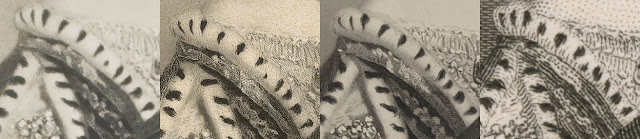 |
| Comparison of underside shading on the ermine border over the Queen's right shoulder (on the left side when looking at the image) |
That same ermine border over the Queen's right shoulder shows underside shading at the upper end in the Wagstaff engraving and little shading down and to the right, almost no shading anywhere in the May 28, 1838 (larger) Cousins engraving, yet both the May 1, 1839 (smaller) Cousins engraving and Humphrys' first Chalon engraving show marked underside shading along the whole length of this ermine border. This seems to confirm that Humphrys indeed used the May 1, 1839 engraving as his source.
Summary
To summarise, there is a contemporaneous letter indicating that Cousins and Humphrys had some level of an engraving-related relationship outside of work hours, and thus there is circumstantial evidence that Humphrys is more likely to have used an engraving by Cousins rather than by another engraver.
To summarise, there is a contemporaneous letter indicating that Cousins and Humphrys had some level of an engraving-related relationship outside of work hours, and thus there is circumstantial evidence that Humphrys is more likely to have used an engraving by Cousins rather than by another engraver.
More compellingly, we can even identify which Cousins version among the five engravings over 1838-1839 was Humphrys' reference: based on a bulge in the ermine border over the Queen's right shoulder and its shading detail, we can posit with some reasonable confidence that it was the later, smaller engraving by Cousins.
Subscribe to:
Posts (Atom)